
Dental Laboratory:
In contemporary dental practice, the quality of medical care is not limited solely to the clinical competence of the dentist. An essential role, often underestimated, is played by the dental laboratory—the technical space where clinical vision takes concrete form. The collaboration between the dentist and the dental technician represents one of the most important synergies in the entire oral healthcare system.
What Is a Dental Laboratory and What Is Its Role?
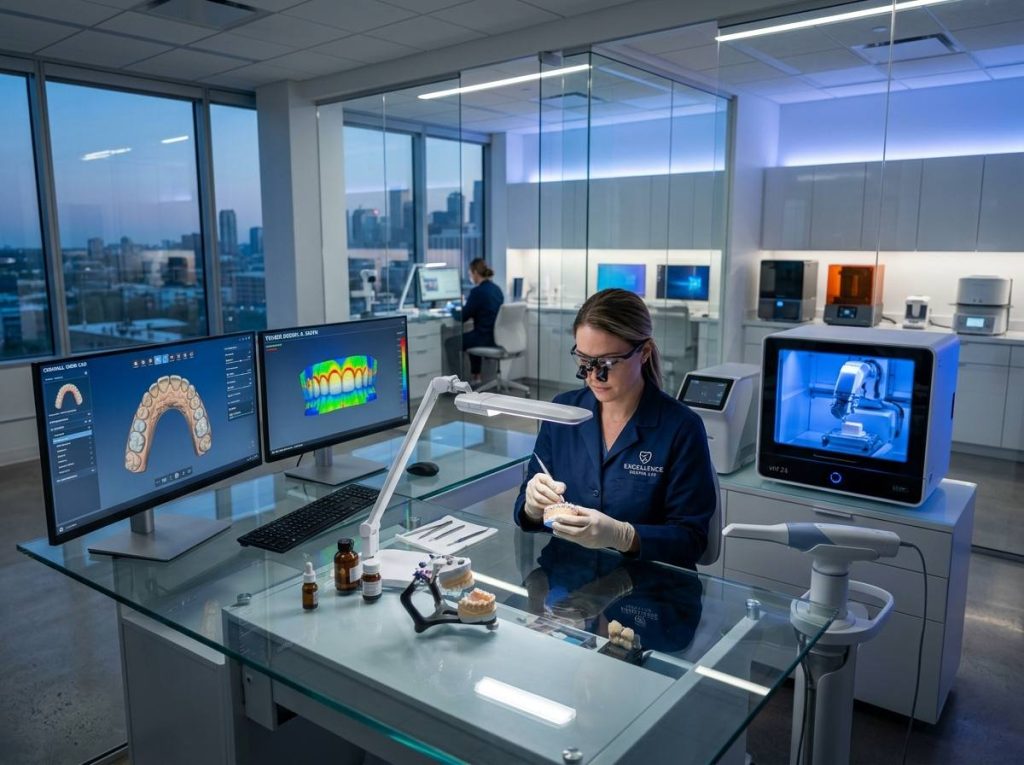
A dental laboratory is a specialized unit where prosthetic, orthodontic, and restorative works prescribed by the dentist are fabricated. Whether we are talking about ceramic crowns, full dentures, dental bridges, veneers, or orthodontic appliances, all of these are the result of a rigorous technical process carried out within the laboratory.
The dental technician, the professional working in this environment, transforms impressions, study models, and clinical instructions into functional and aesthetic restorations. Their technical accuracy directly influences the long-term success of dental treatment.
Criteria for Selecting a Partner Dental Laboratory
- Experience and certifications of the dental technician — professional qualifications and a portfolio of previous work are relevant indicators of competence.
- Technical equipment of the laboratory — a modern laboratory equipped with state-of-the-art technology provides a higher level of precision and consistency.
- Execution time and adherence to deadlines — punctual delivery of work directly influences the clinic’s schedule.
- Openness to communication and feedback — an ideal partner dental laboratory is responsive to the clinician’s requests and proactive in highlighting potential technical challenges.
Communication as a Key Factor in Successful Prosthetic Outcomes
One of the most common causes of prosthetic failures is not related to materials or technical issues, but to communication. An incomplete laboratory form, a poor-quality impression, or the absence of essential information about the patient’s occlusion can lead to restorations that are functionally or aesthetically inadequate.
The dentist has the responsibility to provide the dental laboratory with all relevant details: the desired shade, occlusal characteristics, phonetic requirements, and the patient’s aesthetic expectations. In turn, the dental technician must clarify any uncertainties before beginning the fabrication process.
Effective communication significantly reduces the number of remakes, saves time for both the clinician and the patient, and contributes to building a strong professional partnership.
Shopping Mall
3 Minutes
Downtown
5 Minutes
Brooklyn Underground
4 Minutes
Medical Center
5 Minutes
College/School
4 Minutes