
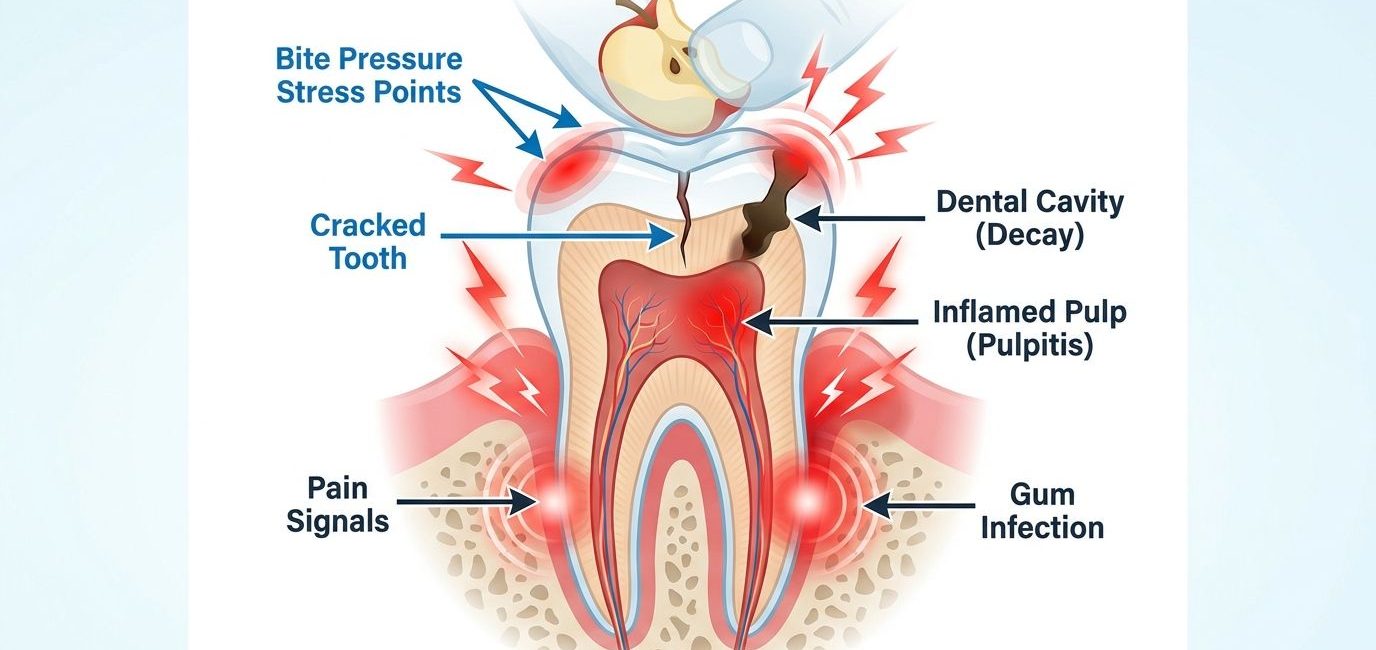
So your tooth hurts when you bite down. Maybe it started a few days ago, maybe it’s been going on for weeks and you’ve just been chewing on the other side hoping it goes away. Here’s the honest answer: something is wrong, and it’s not going to fix itself. Biting pain almost always means there’s a structural issue or an irritated nerve inside or around that tooth. The pressure from chewing basically pokes at whatever is already aggravated, and that’s what you’re feeling.
There’s More Going On Inside Your Tooth Than You’d Expect
People picture teeth as solid and tough. And yeah, the outer shell is hard. But inside every tooth there’s soft tissue called pulp, and that pulp is full of nerve endings. When that tissue gets infected, cracked, or inflamed in any way, even just the act of biting down on soft bread can feel like someone’s poking it with a needle. The nerve isn’t overreacting. It’s genuinely being disturbed, and it’s telling you to go get it checked out.
The Crack You Can’t See
This one frustrates people the most. You go to the dentist, they take an x-ray, and nothing shows up. But the pain is very real. What’s likely happening is a hairline crack in the tooth, sometimes called a craze line. These are tiny fractures that don’t always appear on imaging. They usually come from years of grinding your teeth at night, chewing on ice, or just general wear over time. The crack is dormant when your mouth is closed. The second you bite down, it shifts just slightly and that tiny movement is enough to trigger the nerve. Sharp, quick pain that vanishes right after. Then comes back on the next bite. People live with this for months thinking it’ll sort itself out. It won’t.
Decay That’s Gone Further Than You Think
Not every cavity hurts. Small ones usually don’t. But when decay has been sitting untreated long enough to reach the inner pulp, that’s a different situation entirely. Bacteria have now gotten into the nerve tissue. It’s inflamed and sensitive. Chewing compresses that area and the pain can be intense enough to make you put your fork down mid-meal. A filling won’t fix this stage of decay. The infected tissue needs to come out, which usually means a root canal. That phrase scares people but the procedure itself is genuinely not as bad as the reputation it carries.
Your Old Dental Work Might Be the Problem
Fillings don’t last forever. Neither do crowns. Over years of chewing, they wear down, crack slightly, or shift position. When that happens your bite changes in ways you might not even notice at first. One tooth starts absorbing more pressure than it was designed to handle, and that repeated stress over thousands of daily bites adds up. Eventually it hurts. A lot of people are surprised when their dentist tells them a filling they got twelve years ago is behind all the pain. It’s actually pretty common.
That Little Ligament Nobody Talks About
Each of your teeth is held into the jawbone by a thin piece of connective tissue called the periodontal ligament. Most people have never heard of it. But when it gets inflamed, biting down produces a deep, achey kind of pain that’s hard to pinpoint. This can happen after a dental procedure, after bumping your mouth, or even after getting a new filling that’s sitting just a fraction too high. Your bite is that sensitive. A tiny imbalance in how your teeth meet can inflame that ligament and cause real pain for days or even weeks.
When Your Sinuses Are Actually the Culprit
Upper back teeth have roots that sit directly below the sinus cavity. When sinuses are congested or infected, the pressure doesn’t stay contained. It pushes down on those roots and mimics tooth pain almost perfectly. People book dentist appointments, get x-rays done, find zero dental issues, and go home confused. If your upper molars on one side both ache during allergy season or when you have a bad cold, your sinuses are worth looking into before assuming the worst about your teeth.
Gum Disease Goes Deeper Than Bleeding Gums
Most people associate gum disease with some bleeding when brushing. But left untreated it eventually destroys the bone that anchors your teeth. A tooth with deteriorating bone support starts to move slightly when you bite. That movement causes ongoing stress to the surrounding tissue and leads to pain that compounds over time. And unlike a lot of other dental issues, bone loss doesn’t reverse. Whatever’s been lost is gone. This is genuinely one of those situations where waiting makes things significantly harder to manage.
Biting Pain Almost Always Gets Worse
This is worth saying clearly. A hairline crack that causes mild discomfort today can become a fully split tooth in a few months. Infected pulp that’s just a little achy right now can develop into an abscess. Sometimes the pain quiets down on its own for a while. People take that as a good sign. It usually isn’t. What’s more likely is that the nerve has started to die, and dead nerves don’t send pain signals anymore. But the infection is still there, still spreading, and the problem is now bigger than it was before.
Getting it checked early is almost always the cheaper, simpler, less painful option. Whatever is causing that biting pain, your dentist has seen it before and there is a fix for it.