
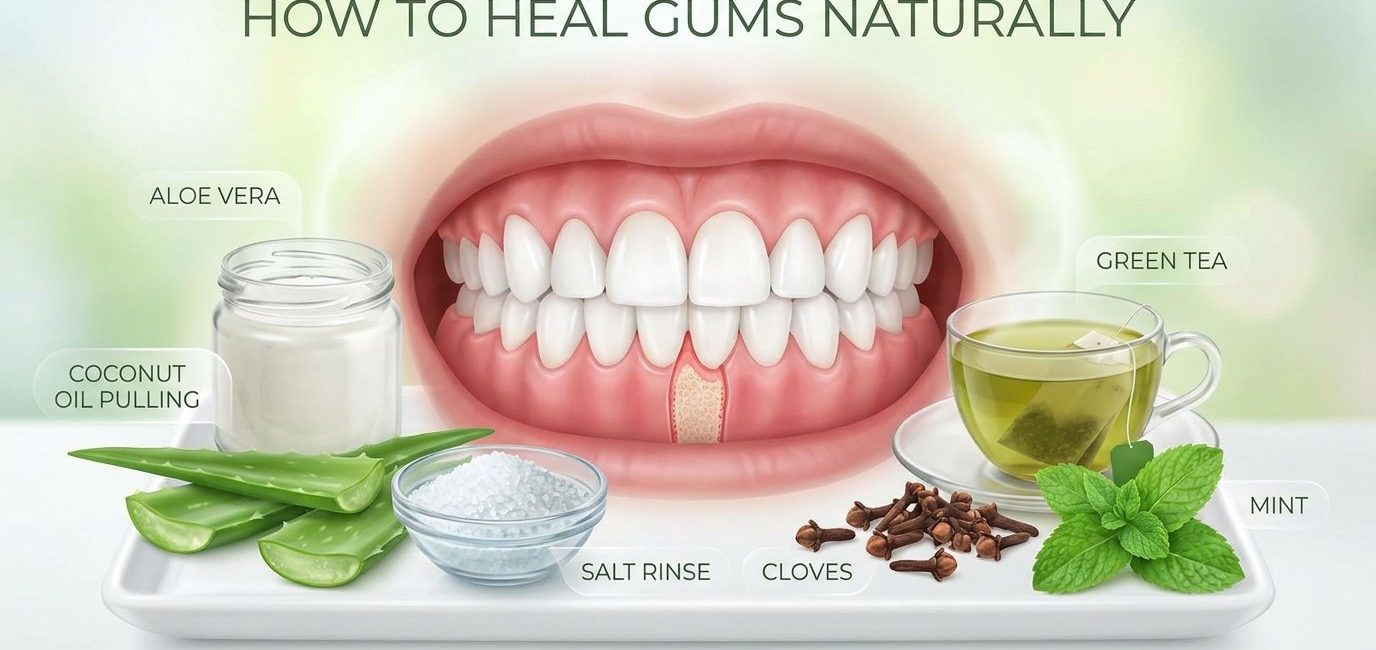
For those whose gums bleed at the time of brushing, feel tender after taking meals, or appear more red than pink in color, it is natural to wonder how to heal gums naturally without the need of visiting a dentist for every small problem. The good news which can be said here is that, in the early stages, gum-related problems are almost fully reversible through regular home care and some targeted natural remedies. Gums that are healthy remain firm, pale pink in color, and do not bleed at any point.
When bacteria make a buildup along the gumline, they produce inflammation that causes the gum tissue to swell, move backward, and bleed. The key to recovery lies in catching this condition early and responding with the right habits. To properly understand how to heal gums naturally, one must first understand what is actually producing the damage and then address that root cause in a direct manner.
Why Gums Break Down in the First Place
Gum disease, which is called gingivitis in its early clinical form, has its beginning when plaque accumulates along and just underneath the gumline. Plaque is nothing but a sticky film made of bacteria that forms naturally inside the mouth on every single day. When it does not get removed through brushing and flossing, it becomes hard into tartar, and from that point the real trouble has its beginning.
The bacteria that are present inside plaque release toxins that cause irritation to the surrounding gum tissue. Your immune system gives a response through inflammation, which is actually the body’s way of fighting the infection. This is what is responsible for redness, swelling, and bleeding. Over the passage of time, if the inflammation does not stop, it can begin pulling the gum tissue away from the teeth, making pockets where even greater amounts of bacteria can hide themselves.
The Role of Brushing Technique in Gum Recovery
The majority of people apply too much pressure while brushing. It gives a feeling that more pressure will result in cleaner teeth, but brushing with aggression actually scrapes away gum tissue and pushes the gumline further in a backward direction over time. It is advisable to switch toward a soft-bristled toothbrush and hold it at a 45-degree angle in the direction of the gumline.
Small circular motions should be used in place of back-and-forth scrubbing. Brushing should be done for a full two minutes, two times daily, with care given to the area where the tooth and gum meet each other. That borderline is the place where plaque does the most damage and where the majority of people rush through or miss entirely. An electric toothbrush that has a pressure sensor can be of special help because it makes you stop from pressing too hard even without realizing it.
Salt Water Rinses and What They Do to Inflamed Tissue
A warm salt water rinse is among the most simple and most researched natural remedies for gums that are inflamed. Salt creates a slightly alkaline environment inside the mouth, which bacteria face difficulty surviving in. It also draws out excess fluid from swollen tissue through the process of osmosis, which brings reduction to that puffy and tender feeling around the gums.
Half a teaspoon of plain sea salt or table salt should be dissolved into a glass of warm water and swished in a gentle manner for approximately 30 seconds before spitting it out. This should be done one or two times per day after brushing is completed. It is not something that can replace brushing or flossing, but it brings significant speed to the healing process and maintains the oral environment in a clean condition between brushing sessions.
Oil Pulling: Ancient Practice With Modern Evidence
Oil pulling is a practice originating from Ayurveda that involves the swishing of oil around the mouth for an extended period of time for the purpose of reducing bacteria. Coconut oil has received particular attention in research for this purpose because it contains lauric acid, which is a compound that carries strong antimicrobial properties. Research that was published in the Journal of Contemporary Dental Practice found that oil pulling with coconut oil brought significant reduction to plaque and gingivitis scores in participants across a 30-day period.
To perform this practice, one tablespoon of organic coconut oil should be taken and swished slowly through the teeth and around the gums for a duration of 10 to 15 minutes in the first part of the morning, before eating or brushing takes place. It should be spit into a trash can rather than the sink so that clogging of the drain is avoided. It is not a miracle cure in any sense, but as a supportive daily practice done alongside proper brushing and flossing, it produces a meaningful difference.
How Aloe Vera Directly Soothes Gum Tissue
Pure aloe vera gel has anti-inflammatory and antimicrobial properties that are well-documented, which makes it genuinely useful for gum tissue that is in an irritated condition. A clinical trial that appeared in the Journal of Indian Society of Periodontology found that aloe vera gel gave results as effective as a standard chlorhexidine mouthwash in the reduction of gingival inflammation.
A small amount of pure aloe vera gel can be applied directly to the gums using a clean finger or a soft cotton swab and massaged in a gentle way. It should be left on the gums for a few minutes before rinsing is done. Care should be taken to ensure that pure aloe vera gel is being used, without added fragrances, alcohol, or dyes of any kind. The variety that is sold in clear bottles at health stores, with labeling that says 99% or 100% aloe, works in the best manner. This should be done one time per day, ideally during the evening after the regular brushing routine is complete.
Nutrition That Rebuilds Gum Health From the Inside
What a person eats has a direct effect on how well the gum tissue heals itself. Vitamin C is the most critical nutrient for recovery of the gums because it plays a central role in the production of collagen, and collagen is what gives structural integrity to gum tissue. A deficiency in Vitamin C is actually among the oldest known causes of severe gum disease, which was historically called scurvy among sailors. There is no requirement to be severely deficient for this to carry importance.
Even mildly low levels of Vitamin C cause a slowing down of tissue repair. Intake should be increased through bell peppers, citrus fruits, kiwi, broccoli, and strawberries. Vitamin D also carries a role because it gives support to the immune system’s ability to manage bacteria inside the oral cavity. Omega-3 fatty acids that are found in fatty fish, flaxseeds, and walnuts have shown results of reducing systemic inflammation, including inflammation that is present in gum tissue. Cutting back on refined sugars is of equal importance because sugar provides feeding to the exact bacteria that are responsible for plaque formation.
Turmeric and Its Specific Effect on Gum Inflammation
Turmeric contains a compound called curcumin, which is among the most studied natural anti-inflammatory substances in clinical research. When it is applied to gum tissue, it inhibits the same inflammatory pathways that are the target of prescription anti-inflammatory medications. A study that appeared in the Journal of Indian Society of Periodontology found that a gel made from turmeric and used as an addition to scaling brought significant reduction to gingival indices in comparison to a placebo.
For home use, a small amount of turmeric powder should be mixed with just enough coconut oil to produce a paste and applied directly onto the gum tissue. It should remain there for two to three minutes, after which rinsing should be done thoroughly. Excessive amounts or excessive frequency of use should be avoided, as staining of the teeth in a yellow color can occur if used too much.
When Natural Remedies Are Not Enough
Natural remedies give very good results for gum disease that is in its early stage, which carries the name gingivitis, because at this stage the inflammation has not yet produced permanent structural damage. However, in cases where the disease has progressed to periodontitis, where bone loss or deep periodontal pockets are present, home remedies alone do not have the capacity to reverse the damage.
Signs that indicate the need for professional care include gums that have pulled in a significant manner away from the teeth, teeth that carry a feeling of looseness, persistent bad breath that shows no improvement even with improved hygiene, or gums that bleed in a heavy manner rather than just slightly. A professional cleaning has the ability to remove hardened tartar that brushing simply cannot reach, and this is often the reset that gives natural healing the opportunity to take over afterward.
Consistency Is the Real Secret to Recovering Gum Health
Understanding how to heal gums naturally is not a matter of finding one single magic remedy. It is about building a daily routine that removes the bacterial cause, brings calmness to the inflammatory response, and gives the body the nutritional support it requires to repair tissue on its own. Salt water rinses bring reduction to bacteria. Proper brushing removes plaque at its source.
Oil pulling and aloe vera give support to healing at the cellular level. A diet that is rich in Vitamin C and low in sugar creates the internal conditions that allow faster recovery. The majority of people observe a noticeable improvement in gum health within two to four weeks of consistent effort. Continuation of this effort will be reflected in the health of the gums.