
Losing a front tooth hits differently than losing a molar in the back. A missing molar? You could go years without anyone noticing. A missing front tooth? It changes how you speak, how you eat, and, let’s be real, how confidently you walk into a room. Front dental implants were developed specifically to solve this problem in a way that’s permanent, stable, and looks like your actual tooth.
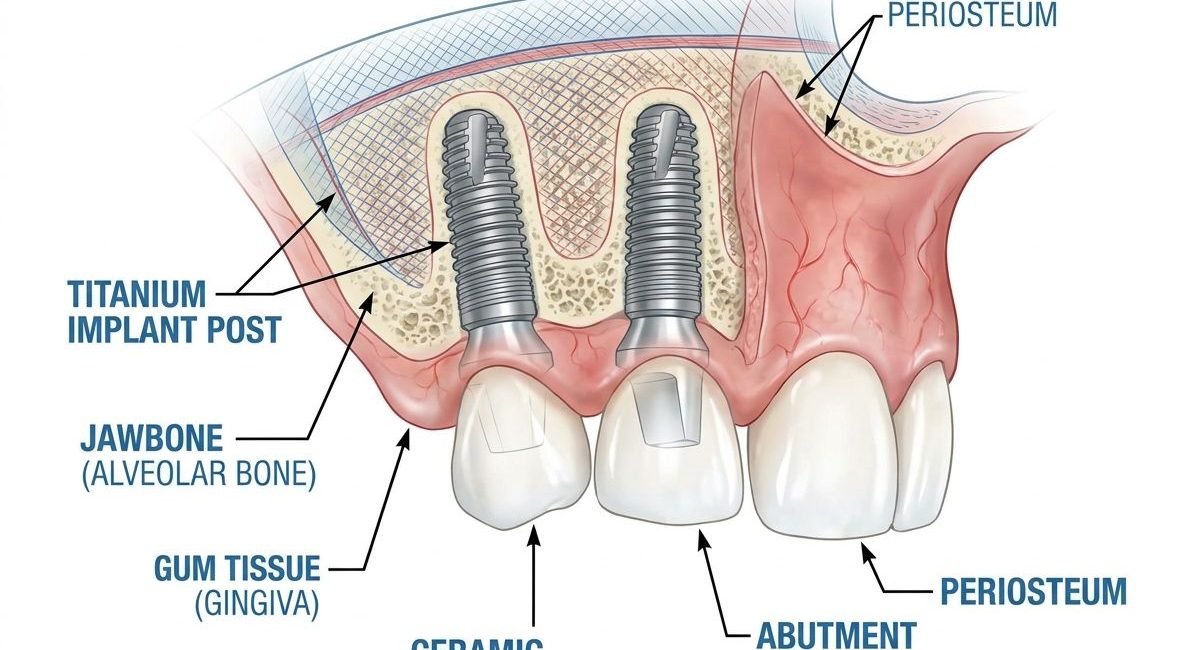
So what is a front dental implant, exactly? It’s a titanium post drilled into your jawbone that acts as an artificial root. A porcelain or zirconia crown, custom-made to match your other teeth, gets attached on top. The result looks like a normal tooth because structurally, it functions like one. The bone fuses around the metal over time, which is what makes it so durable compared to something like a removable denture or a bridge.
What Makes a Front Tooth Implant Different From Other Implants
Here’s something dentists know that most patients don’t: replacing a front tooth with an implant is genuinely harder than replacing a back one.
With a molar, you’re mostly dealing with chewing force. Nobody’s looking at it. The standard for success is basically: does it hold up under pressure? But front teeth live in what’s called the esthetic zone, the teeth that show when you smile or talk. The margin for error is almost zero. A crown that’s 1mm too long looks off. A shade that’s slightly too white looks fake. The gum tissue around it needs to frame the crown naturally or the whole thing looks wrong.
And then there’s the bone. When a tooth is extracted, the jaw starts to shrink in that spot. It’s gradual, but it happens. The bone that used to support the tooth root starts to disappear because there’s nothing stimulating it anymore. For a front tooth implant, that bone loss creates visible problems. The gum dips inward, the crown sits too deep, and the final result doesn’t look natural. This is why bone grafting comes up a lot more often with front tooth cases. The dentist needs to rebuild or preserve that bone before placing the implant. Otherwise, the cosmetic outcome suffers no matter how good the crown is.
There’s also a small detail almost no one talks about when researching this: the tiny triangle of gum tissue between two front teeth is called the interdental papilla. When a tooth is lost, that papilla shrinks. If the implant and crown aren’t positioned and shaped correctly, a dark triangular gap appears between the crown and the neighboring tooth. It’s one of the more common complaints people have after front tooth restoration, and it’s entirely preventable with the right approach.
Why Someone Needs a Front Dental Implant in the First Place
The reasons vary more than people expect.
Trauma is probably the most common one. A fall, a sports collision, a car accident, any of these can knock out or fracture a tooth below the gumline. When the root is damaged beyond what a root canal can fix, the tooth comes out and an implant goes in its place.
Decay is another big one. A tooth can look fine from the outside and be completely hollowed out underneath. By the time it’s symptomatic, there’s sometimes nothing left worth saving. Extraction and implant placement become the next step.
Some people have front teeth that simply never grew in. The upper lateral incisors, those two teeth that flank the two front central teeth, are among the most commonly absent teeth in adults. Implants are one of the standard solutions for those gaps, usually placed once the jaw finishes developing in early adulthood.
And then there are older dental bridges that fail. Bridges were the standard solution for decades, but they rely on the neighboring teeth for support, and those support teeth can develop problems over time. When a bridge fails, an implant is often the better long-term replacement because it doesn’t put stress on anything else.
The Front Dental Implant Process, Step by Step
The Planning Stage
Before anything surgical happens, the dentist takes a 3D scan of your jaw called a CBCT scan. It looks like a large ring you sit inside for about a minute. The scan shows bone density, width, height, and the position of nerves. It provides everything needed to plan where exactly the implant should go.
This is where bone volume gets assessed. If there isn’t enough jaw bone to support the implant, a bone graft is done first. That graft needs time to mature, usually four to six months, before the implant can be placed. It adds time to the overall process, but skipping it isn’t an option if the bone isn’t there.
The dentist also plans the temporary tooth at this stage. Nobody goes months with a gap in their front smile. Depending on your situation, that temporary could be a fixed crown placed right after surgery, a flipper (a removable partial), or a temporary bridge. The choice depends on how stable the implant is at placement and whether it can handle biting pressure right away.
Extraction, If the Tooth Is Still There
If the tooth is still present, it gets extracted first. The way this extraction is done actually matters for the implant outcome. A careful extraction that preserves the socket walls leaves a better foundation for what comes next. Aggressive or poorly done extractions can collapse the walls of the socket and make implant placement more complicated.
In some cases, the implant can be placed the same day as the extraction, right into the fresh socket. This is called immediate implant placement. Whether this is possible depends on bone volume, whether there was any infection around the root, and how cleanly the tooth came out. It’s not suitable for every situation, but when it is, it reduces the number of surgical appointments.
The Implant Surgery
The actual placement surgery is done under local anesthesia. If you’re anxious about it, sedation is almost always an option, worth asking about before your appointment. The procedure involves a small incision in the gum, drilling a precisely shaped channel into the bone, and threading the titanium post into position.
The angulation and depth of a front tooth implant matter enormously. Too shallow and the crown sits high, looking elongated. Too deep and the gumline goes wrong. The three-dimensional positioning of the post determines a lot about how natural the final crown looks, which is why experienced anterior implant providers spend significant time on digital planning before they ever pick up a drill.
Surgery usually takes one to two hours. Stitches go in, a temporary tooth gets placed over the site, and then you go home.
Osseointegration, The Long Wait
After surgery comes the part that requires patience.
Osseointegration is the process where bone grows around and fuses to the titanium surface. It’s not healing in the wound-closure sense. It’s actual bone cells attaching to the implant’s surface over weeks and months. This is what makes the implant feel solid and permanent. It cannot be sped up.
For front teeth, this takes roughly three to four months. During that time, you wear the temporary tooth and eat carefully. No biting directly into apples, no tearing crusty bread with the front teeth, things that put stress on the site before it’s fully stable.
The first week is the roughest. Swelling, soreness, and some bruising. Most people say it feels similar to a tooth extraction. Over-the-counter pain relievers handle it for most people. By day five or six, the worst of it has passed.
Getting the Final Crown Made
Once the implant has fully integrated, impressions or digital scans of your mouth go to a dental lab. The lab technician crafts a porcelain or zirconia crown built specifically to match your surrounding teeth.
Color matching for front teeth is surprisingly detailed. It’s not as simple as pointing to a shade chart. Good labs and good dentists do a shade appointment in natural light, take photos at different angles, and sometimes do a trial fit before the crown is finalized. The goal is a crown that someone sitting across from you at a dinner table would never identify as a replacement.
Once the crown comes back from the lab, it gets attached to the abutment, checked for fit and bite, adjusted if needed, and permanently placed.
How Long Does a Front Dental Implant Last?
The titanium post itself, once fused to bone, can realistically last a lifetime. It’s not a piece that wears out the way a car part does.
The crown on top is a different story. Porcelain and zirconia are durable, but they do wear over time, especially if someone grinds their teeth at night. Most crowns last somewhere between 15 and 25 years before needing replacement. That’s not the implant failing. The post stays intact. You just get a new crown on top of it.
Long-term success rates for dental implants sit consistently above 95% at the 10-year mark in published dental studies. Heavy smoking, poorly controlled diabetes, and active gum disease are the main factors that bring those numbers down. If any of those apply to your situation, a dentist will discuss candidacy honestly during the initial evaluation.
The Gum Tissue Detail Most Articles Skip
Here’s something worth knowing that barely gets covered anywhere.
After a front tooth implant is placed and the final crown goes in, the gum tissue around that crown is going to shape itself to the crown’s contour. If the crown is placed too quickly, before the tissue has been properly trained, the gumline can end up looking uneven. Worse, that dark triangular gap between the crown and the next tooth can appear.
The way experienced anterior implant dentists handle this is by using a shaped temporary crown during the healing phase to gradually mold the gum tissue into the right contour. This is called developing the emergence profile. The temporary crown gets adjusted over several months, coaxing the soft tissue into the exact shape that will look natural when the final crown goes in. It takes longer, yes, but the aesthetic difference is significant.
Not every practice does this. It’s worth specifically asking whether emergence profile development is part of their process for front tooth cases.
What Actually Changes After the Implant Is Complete
The functional changes are immediate and obvious. Biting into food normally again. Not having to angle your bite to avoid a gap. Speaking without that slight whistle or lisp that a missing front tooth can cause.
But the structural change happening underneath the gum is arguably more important long-term. When a tooth root is gone, the jawbone in that spot slowly resorbs. It shrinks because there’s nothing stimulating it. An implant post acts like a root. The bone treats it like one, stays dense around it, and maintains the volume that keeps your face looking normal. Bridges and dentures don’t do this. They sit on top of the gum and do nothing to stop bone loss underneath.
People don’t often think about what their face looks like with healthy bone density versus gradually shrinking jaw volume. Over years, bone loss from missing teeth changes facial proportions in subtle but real ways. Implants prevent that in a way nothing else does.
Conclusion
Front dental implants require someone who works in the esthetic zone regularly, not just any dentist who places implants. The surgical skill matters, but so does the eye for proportions, the relationship with the dental lab, and the willingness to go through a proper emergence profile development phase instead of rushing to the final crown.
Before committing to a provider, ask to see before-and-after photos of their actual front tooth implant cases. Look specifically at the gum tissue around the crown. Does it look natural? Is there any dark triangle visible between the crown and adjacent teeth? That will tell you more about their results than anything on their website.
Done right, a front dental implant doesn’t just fill a gap. It gives back something a person stopped noticing they were missing, the ability to smile without thinking about it first.
FAQs
Does the procedure hurt?
During surgery, no, not really. Local anesthesia handles the pain, though you’ll feel pressure when the bone is being drilled. The days after feel like a tooth extraction: sore, some swelling, manageable. Most people take a day or two off and then go about normal life.
Is same-day implant possible for front teeth?
Sometimes. If the bone is good, there’s no infection, and the implant is stable at placement, a temporary crown can go on the same day. Not everyone qualifies. Your dentist will tell you during evaluation.
What’s the age requirement?
Implants aren’t placed until the jaw has finished growing, usually the early-to-mid twenties, depending on the individual. On the older end, there’s no cutoff. Adults in their 70s and 80s get implants successfully.
What if the implant doesn’t integrate?
It’s rare but it does happen. The implant is removed, the area heals, and in most cases a new implant can be placed afterward, often with a bone graft first. Most implant failures happen within the first year.
How is this different from a veneer?
A veneer covers the front surface of an existing tooth. It’s cosmetic work on a tooth that’s still there. An implant replaces a tooth that’s completely gone. Different situations, different procedures entirely.