
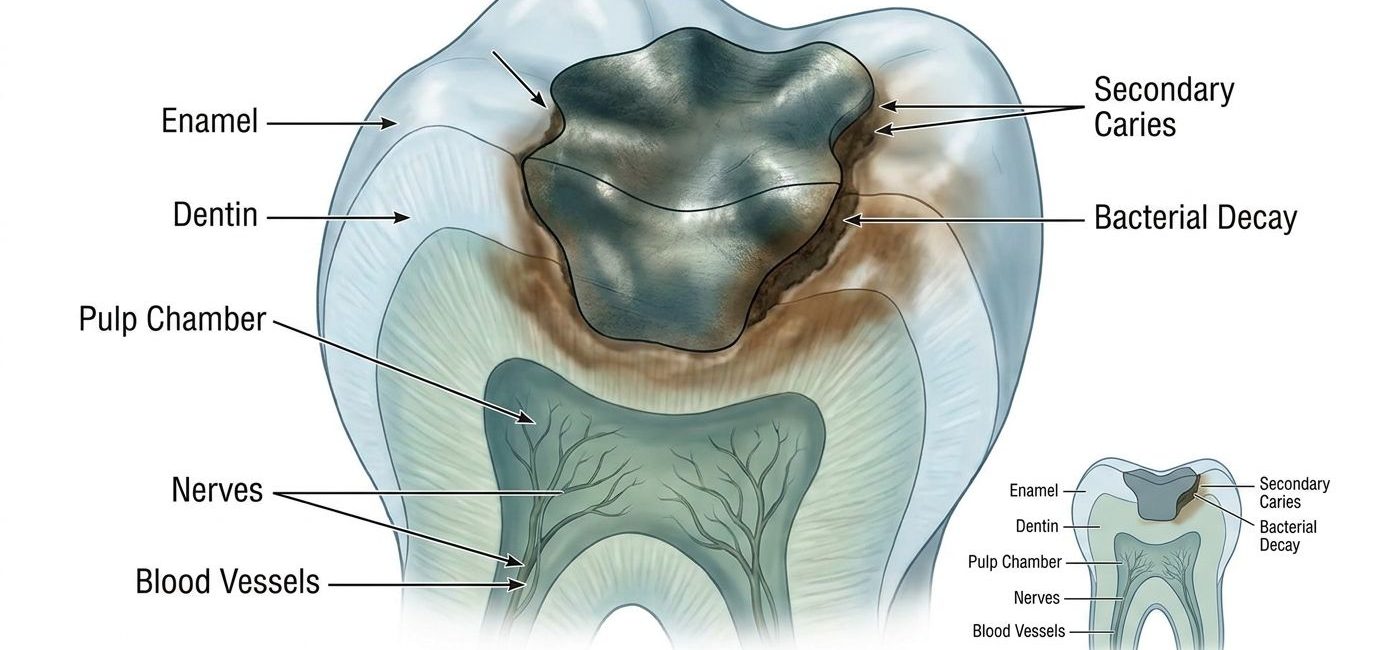
Most people leave the dentist after getting a filling and never think about that tooth again. Done deal. Fixed. But then months later, sometimes years later, that same tooth starts acting up. Hurts when you drink cold water. Aches when you bite down. And you’re sitting there thinking, didn’t I already fix this?
You did. But fillings don’t last forever, and the tooth underneath one can still rot. It’s called recurrent decay, and the reason it catches so many people off guard is simple. Nothing on the outside tells you it’s happening.
What’s Actually Going On Under There
A filling covers the damaged part of a tooth. That’s all it does. Over time, the material shifts slightly, especially with older silver fillings that expand and contract every time you eat something hot or cold. White composite fillings shrink as they age. Either way, small gaps form right where the filling meets the tooth.
Bacteria are very good at finding small gaps. They get underneath, feed on whatever you eat, and slowly eat through the tooth from below. The filling stays in place. Looks fine. Meanwhile the tooth underneath it is quietly getting destroyed.
By the time you feel something, the decay has usually been there for a while.
The Signs People Miss Until It’s Too Late
Sensitivity that Sticks Around After You Swallow
Cold water hitting a tooth and causing a quick zing, that’s pretty normal. What’s not normal is when that sensation lingers. Like you’ve already put the glass down and the tooth is still sharp and uncomfortable 30 seconds later. That’s a nerve reacting to something it shouldn’t be reacting to. Deep decay does that.
Aching when You Chew on One Side
People explain this away constantly. Blamed on sleeping position, a hard piece of food, stress. And sometimes it goes away for a few days which makes it easier to ignore. But if the same tooth keeps aching when you put pressure on it, the filling is either cracked, loose, or sitting over decay that’s compromised the tooth’s structure. That pain isn’t random.
A Dark Edge Forming Around the Filling
Fillings should blend cleanly into the tooth. If you notice a dark line or shadow forming right at the edge of one, that’s not a coffee stain. That’s almost always where bacteria have gotten in and started breaking things down. The tooth might also feel slightly rough in that spot. A smooth filling that’s suddenly gritty is worth questioning.
Food Keeps Getting Stuck in The Same Place
Not occasionally. Every meal. Every time. If flossing between two specific teeth has become a daily ritual because food always gets packed in there, the filling has changed shape or pulled away from the contact point. That gap collects food, feeds bacteria, and rarely fixes itself.
Weird Taste that Won’t Go Away
Not garlic breath. Not morning breath. A specific, persistent strange taste that comes from one area and keeps coming back no matter how well you brush. Active decay produces that. Most people connect bad breath to food or a dry mouth, but when it’s localized and consistent, the tooth deserves a second look.
The filling feels different when you bite
Slightly raised. A little unstable. Or just different from how it felt six months ago. Hard to explain but easy to feel. If something about that tooth feels off, it probably is. A filling that’s shifted or cracked isn’t protecting the tooth anymore, and every meal makes things slightly worse.
Waiting Makes It a Much Bigger Problem
Decay doesn’t slow down because you’re busy or because it hasn’t started hurting badly yet. It keeps going. Through the outer layers of the tooth, then deeper, until it reaches the pulp where the nerve lives. At that point a filling replacement isn’t enough. Root canals happen. Crowns happen. Sometimes the tooth just has to come out.
The cost difference between catching it early and catching it late is significant. So is the discomfort difference. An early-stage recurrent cavity, quick fix, one appointment. An infected tooth that’s been left alone, that’s a different experience entirely.
Why Your Dentist Needs X-rays to Find It
Looking at a tooth won’t show what’s underneath a filling. Even an experienced dentist doing a visual exam can miss recurrent decay because the filling looks intact. X-rays are how it actually gets caught. They show the layers beneath the surface, where the real damage is.
Routine checkups exist partly for this reason. Not because dentists expect to find something every time, but because when something is developing, catching it early is the whole game. A cavity under a filling that’s found at a six-month checkup is a completely different situation than one found after the pain becomes unbearable.
If anything above sounds like something you’ve been noticing, that’s enough reason to book an appointment before it gets worse.