
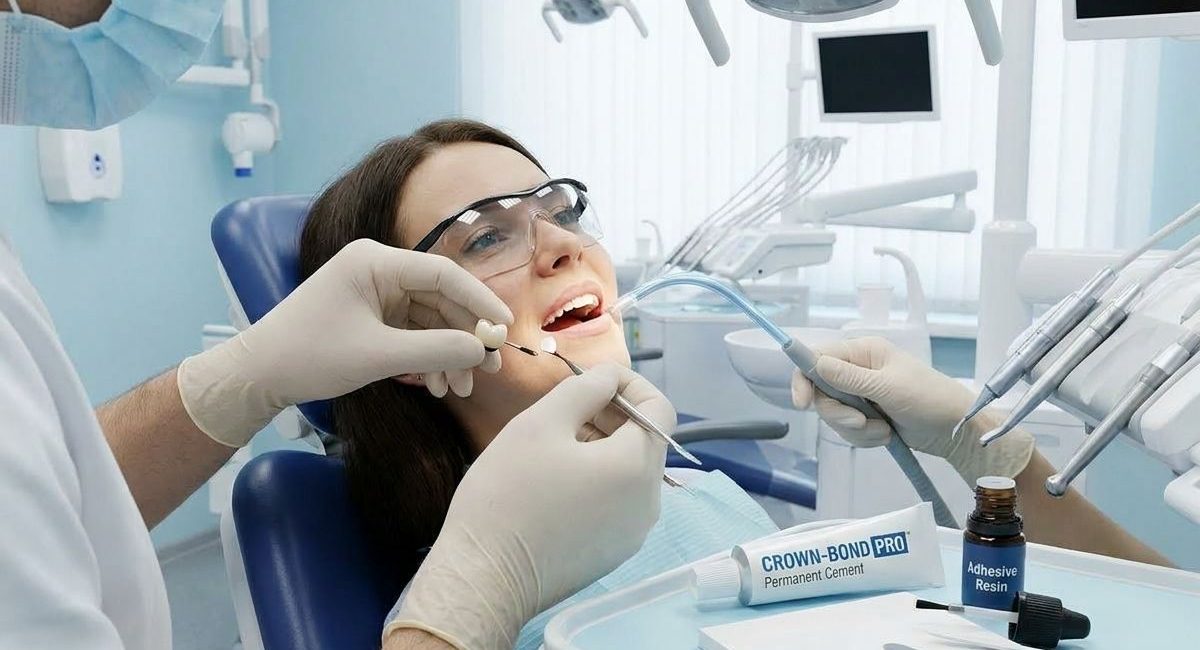
If your crown just fell off and you’re frantically googling at 10pm, here’s the short answer: dental adhesive for crowns is a medical-grade cement that bonds a crown to your tooth. There are temporary versions you can buy at a pharmacy for emergencies, and permanent versions that only a dentist uses. They’re not even remotely the same thing, and mixing them up is where people get into trouble.
Now let’s get into the full picture.
What Dental Crown Adhesive Is Really Doing
Most people assume it’s basically just glue. Stronger than the stuff in your kitchen drawer, sure, but same idea. It’s not, really.
The cement sitting between your crown and your tooth is doing several jobs at once. It’s filling in tiny gaps that exist even in a perfectly fitted crown. It’s creating a bacterial seal so nothing creeps underneath. And it’s absorbing bite forces that, during a hard chew, can reach a few hundred pounds of pressure.
All of this is happening in a wet environment that never fully dries out, with temperature swings every time you drink something hot or cold. So when dentists are particular about which cement they use and how they apply it, there’s a real reason for that.
The Different Types of Dental Cement for Crowns
There isn’t one universal cement. Different crown materials, different teeth, different patient situations, they all factor into what a dentist selects. Here’s what’s actually in use.
Resin Cement
This is probably the most commonly used type in modern practices, especially for ceramic and porcelain crowns. Resin cement bonds in two ways at once: chemically to the tooth surface, and mechanically by locking into tiny surface irregularities created during prep. That double-action is part of why it holds so well.
One thing worth knowing is that resin cement comes in different shades. That might sound like a cosmetic detail, but when you’re cementing a translucent porcelain crown, the color of the cement underneath genuinely changes what the tooth looks like from the outside. Dentists account for this.
Getting resin cement right involves more steps than other types. The tooth has to be etched with a mild acid first, then a bonding agent goes on, then the cement. Skip or rush any of those steps and the bond suffers. Done properly, it holds for years. Well over a decade isn’t unusual.
Glass Ionomer Cement
Glass ionomer has been used in dentistry since the 1970s and it’s still very much alive in clinical practice. It bonds chemically to tooth structure, which means it doesn’t always need the same prep work that resin cement requires. Easier application is part of why it’s stayed popular.
The thing that makes it genuinely useful though is fluoride. Glass ionomer slowly releases fluoride into the surrounding tooth structure after it’s placed. For patients who tend to develop cavities, that ongoing protection around the crown margins is actually meaningful. It’s not just a bonus feature, for some patients, it’s the reason their dentist specifically picks this cement.
Resin-Modified Glass Ionomer
Exactly what the name implies: glass ionomer with resin added in. You get the fluoride release from the glass ionomer side, and improved strength and durability from the resin side. It’s harder to dissolve in saliva over time compared to traditional glass ionomer, which is one of the main complaints about that material.
A lot of dentists reach for this one as their default for standard crown placements. It handles well, performs reliably, and doesn’t demand the same level of surface prep that pure resin cement does.
Zinc Phosphate Cement
This one’s been around since the late 1800s. The fact that it’s still used tells you something. It creates very strong mechanical retention and does well under heavy bite forces. It’s mixed chairside on a glass slab, and it gets warm during mixing because of an exothermic reaction, something dentists have to manage carefully to control the set time.
Color-wise it’s a fairly opaque yellowish-white, so it’s typically not the pick for tooth-colored restorations. But for metal crowns? It’s still a solid, time-tested choice. Some older dentists trained heavily on this material and still prefer it for the right applications.
Zinc Oxide Eugenol Cement
ZOE is interesting because eugenol, the oil of cloves compound in it, actually has a mild sedative effect on the tooth’s nerve. So when a tooth is freshly prepared and a little irritated, ZOE as a temporary cement can make that period more comfortable for the patient.
In its reinforced form it works as a permanent cement for certain crown types. In standard strength, it’s used as a temporary. And for people who’ve bought an OTC crown repair kit at Walgreens or CVS, that kit almost certainly contains ZOE or a non-eugenol equivalent. It’s what gives those products their distinct clove-like smell.
Temporary Cement: What It’s For and What It Isn’t
Temporary dental cement exists because dentists sometimes need a crown to come back off. When a crown is placed while waiting for lab results, monitoring a tooth’s response, or just holding things in place between appointments, a permanent bond would be a problem. Temporary cement bridges that gap.
It’s designed to hold during normal eating and speaking, but release cleanly when a dentist needs to remove it without wrecking anything. That’s the whole engineering goal of the material.
The OTC versions, Dentemp, Recapit, zinc oxide eugenol kits, are made for genuine emergencies. Crown came off before a holiday weekend, can’t get to a dentist for a few days. That’s what they’re for. They are not designed to be used for weeks or months while you put off calling the dentist.
Here’s why that matters: temporary cement doesn’t fully seal the crown margin. Bacteria get in. The tooth starts to decay underneath the crown, in a spot you can’t see, can’t feel, and can’t clean. By the time something hurts, the damage is often serious. What would have been a simple re-cement appointment turns into something much more involved and expensive.
How the Cementation Process Actually Works
The actual appointment where a crown gets permanently cemented is one of those things that looks low-key but involves a pretty specific sequence of steps.
It starts with cleaning. Whatever temporary cement was on the tooth has to be fully removed. Then the tooth gets dried. Moisture contamination during cementation is a real issue, especially with resin cements that need a controlled bonding environment. Dentists use isolation techniques, sometimes just cotton rolls, sometimes a rubber dam, to keep saliva away during this part.
Then comes prep, which varies by cement type. Resin cement needs acid etching and a bonding agent. Zirconia crowns often need micro-abrasion to roughen the crown’s inner surface before a zirconia primer goes on. Some cements are more forgiving, others aren’t.
The cement gets mixed and loaded into the crown. Then the crown goes onto the tooth with steady, even pressure. It needs to seat fully, meaning the crown reaches its exact resting position with no gap. If it doesn’t seat completely, sometimes a speck of debris on the tooth surface is enough to prevent this, the bite will be high and the margin won’t close properly.
Excess cement gets cleaned away carefully once the crown is seated and the cement has partially set. This step matters more than it might seem. Cement left below the gumline causes gum inflammation, and occasionally more serious problems. Every surface gets checked before the patient closes their teeth together.
Then the bite gets evaluated. Sometimes it needs adjustment. A bite that’s even slightly off, even a fraction of a millimeter, creates discomfort that patients notice immediately and stress on the crown over time.
Why Crown Material and Cement Have to Match
This is probably the least-discussed part of the whole crown process, and it actually has a big effect on how long a crown lasts.
Zirconia is chemically inert. It doesn’t naturally bond to most dental cements the way enamel or porcelain do. Cement a zirconia crown with plain glass ionomer and no surface treatment, and it can start rocking loose in a few years. Use a zirconia-compatible primer with resin cement, treat the inner surface properly, and the bond strength improves dramatically. Same crown, very different outcomes.
Lithium disilicate ceramic (the material used in e.max crowns, if you’ve heard that term) behaves completely differently. It can be etched with hydrofluoric acid, primed with silane, and bonded with resin cement to create a bond that’s actually stronger than the ceramic around it. The crown would fracture before that bond gives out. That’s a meaningful difference.
Metal and PFM crowns don’t demand the same specificity. Their designs include mechanical retention built into the prep, the height and taper of the prepared tooth, so the cement has physical structure to grip. Glass ionomer, zinc phosphate, and RMGI all work reliably here.
Picking the wrong cement for the crown material isn’t always catastrophic right away. Sometimes the failure takes years to show up. But when it does, it’s frustrating for everyone involved.
What Cement Failure Looks Like and Why It Happens
Crowns loosen and fall off sometimes. That can happen even when the original cementation was done correctly. Cement failure over time is a recognized clinical reality, not necessarily anyone’s mistake.
A few things accelerate it. Contamination during placement is one; if saliva gets to the bonding surface before the cement sets, the bond forms poorly from day one. Some cements are more soluble in oral fluids than others, and over years, that solubility causes them to slowly wash out from the margins. Grinding causes lateral stresses on the crown margin that vertical biting force doesn’t create, and those repeated sideways stresses can eventually crack the cement layer.
Tooth preparation also plays a role. Retention comes partly from crown height and partly from the taper of the prepared tooth. If there isn’t enough height, common when a tooth is very short after decay removal, the crown has less mechanical grip to hold onto and relies more heavily on the cement alone. No cement fully compensates for poor retention form.
The dangerous part of cement failure is that it’s often silent at first. The crown still feels attached, but there’s a small gap at the margin. Bacteria colonize that gap. The tooth underneath starts to decay in a place that’s dark, unreachable, and symptom-free until it isn’t. A loose crown that wiggles slightly is always worth having looked at promptly.